

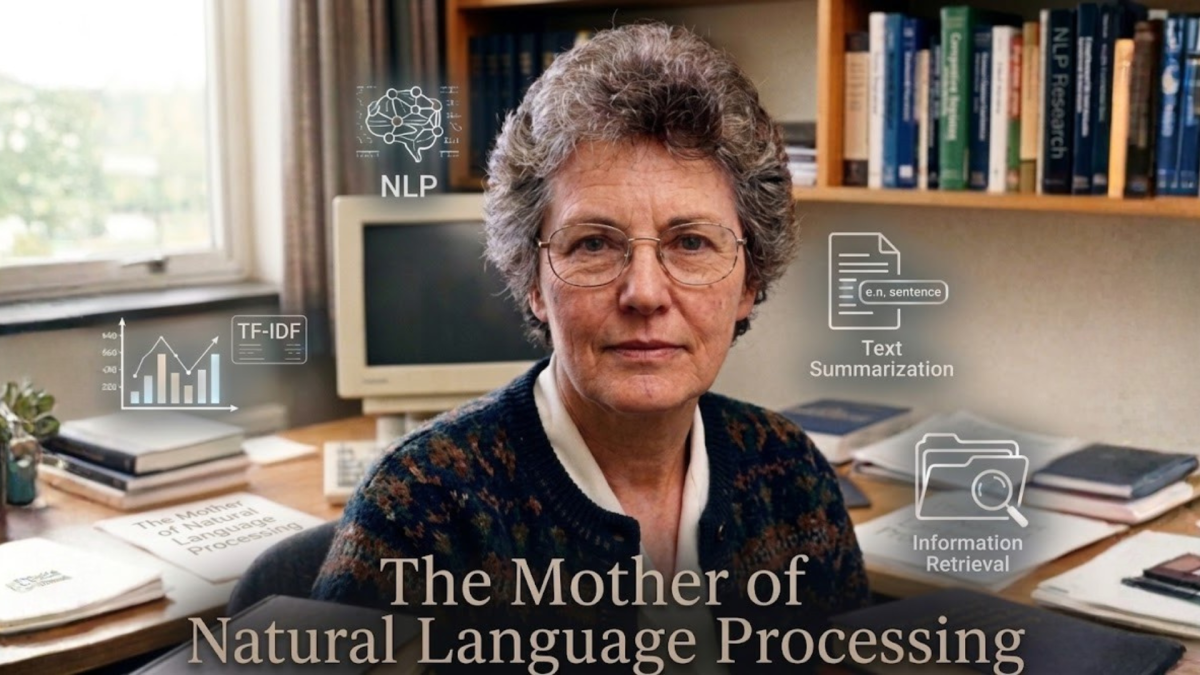
Karen Spärck Jones (1935–2007) was not a household name during most of her life, yet her intellectual DNA is encoded into the very fabric of our modern existence. She taught machines how to understand human language structure, paving the way for the information revolution. This article explores her legacy through three complementary facets of her remarkable career.
The Revolutionary Idea Inverse Document Frequency (IDF)
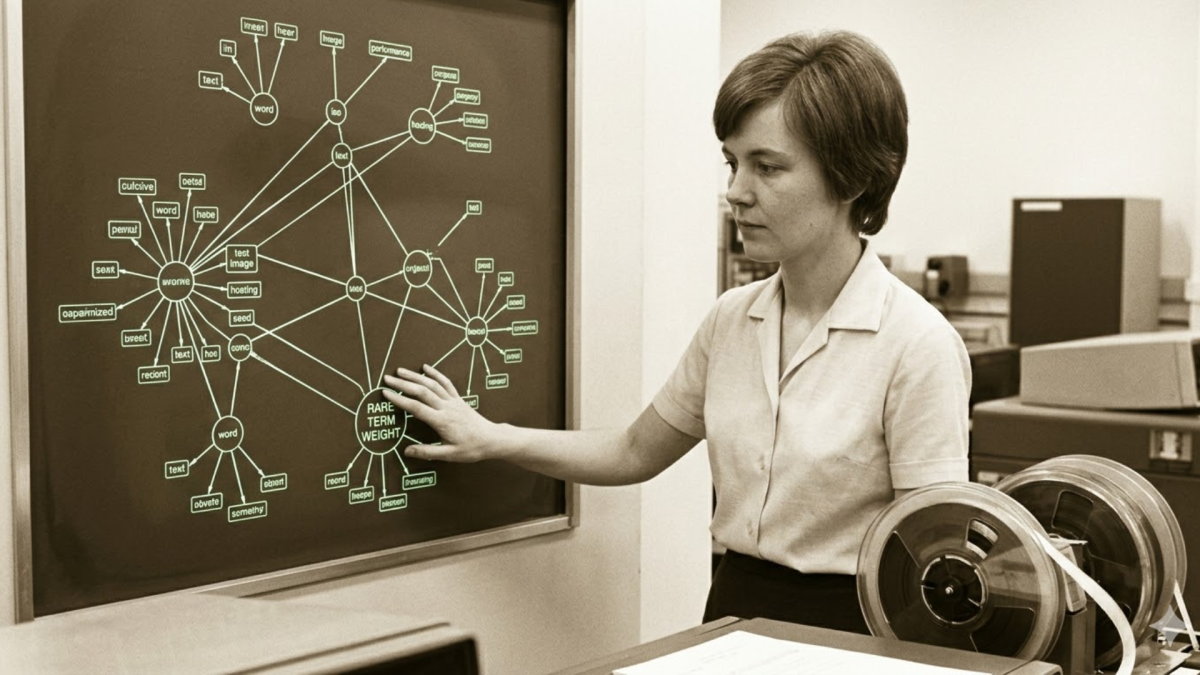
In the late 1960s, computers treated all words equally. A search for "the theory of bioluminescence" would return thousands of documents that merely contained the word "the" or "of," making the results useless. Spärck Jones recognized that the statistical distribution of words was key.
Her 1972 paper introduced Inverse Document Frequency (IDF). The concept is deceptively simple but profoundly powerful: If a word (like "the") appears in virtually every document, it provides almost no specificity for search and should be weighted low. However, if a word (like "bioluminescence") appears in only two or three documents out of millions, it is highly specific and should be weighted extremely high.
This ranking system weighting "rare" words highly allowed computers, for the first time, to effectively rank information by relevance. This methodology remains the core component of TF-IDF, an algorithm still used as a benchmark by search engine giants like Google. Her work provided the statistical breakthrough required to navigate the digital universe.
Bridging the Gap Linguistics Meets Computer Science
Karen Spärck Jones was not conventionally trained in computer science. Her background was in History and Philosophy (specifically ethics), which gave her a sophisticated understanding of language and human communication structure knowledge often missing in purely technical fields.
She realized that logic alone was not enough, machines needed to interpret semantics (meaning) within context. She became a founding figure in Natural Language Processing (NLP), dedicating her career to bridging the gap between human linguistics and machine computing. Her research at the Cambridge Language Research Unit (CLRU) focused on using computational models to understand the "thesaurus" structure of language, enabling finer distinctions in meaning than simple keyword matching. This holistic approach ensured that search and language models evolved beyond simple math into tools that could navigate the nuance of human expression.

Computing is Too Important to Be Left to Men - Advocacy and Recognition
Spärck Jones was keenly aware that computer systems, which increasingly organize society, must be built by diverse teams to avoid bias and incorporate 'thoughtful' design.
For much of her career, she worked in senior research posts supported entirely by external grants. She was not appointed a full Professor at Cambridge until 1999, remarkably late given her monumental contributions and just eight years before her passing. Only very late in life did she receive mainstream validation: she was the first woman to receive the prestigious Lovelace Medal from the British Computer Society in 2007. Posthumously, her stature has only grown, cemented by recognitions like the New York Times "Overlooked" obituary in 2019. Karen Spärck Jones proved that the intellectual foundations of the digital future were built by women who mastered the statistics of language.
Conclusion: A Lasting Legacy: The Woman Who Defined the Digital Search
Karen Spärck Jones was a visionary who saw the potential of computing long before the rest of the world caught up. By combining the precision of mathematics with the nuance of linguistics, she provided the "GPS" needed to navigate the vast digital landscape we live in today. From the creation of the IDF algorithm to her tireless advocacy for women in technology, her legacy isn't just found in history books, it’s found in every search bar on the planet. She proved that for technology to truly serve humanity, it must first understand how we speak, how we think, and who we are.