

As Artificial Intelligence integrates across industries, the question of its impact on the workforce has moved from speculative fiction to critical economic analysis. Anthropic, a leader in AI research, has published a pivotal report introducing a novel methodology to measure this impact with unprecedented precision.
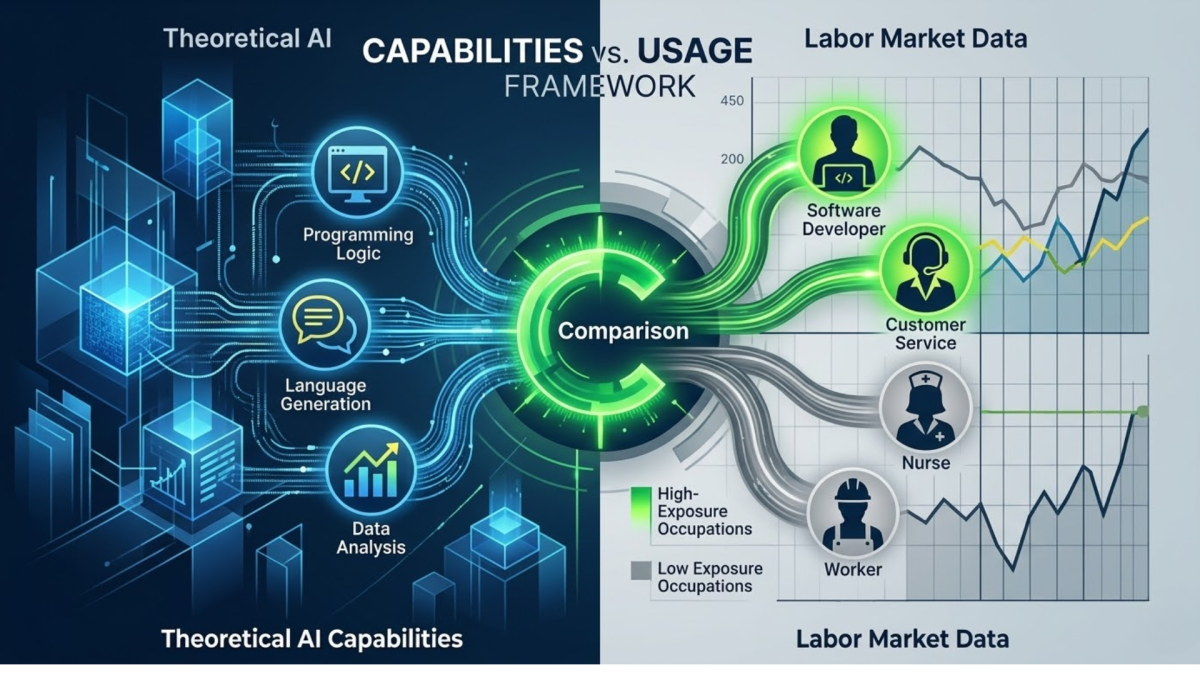
The core innovation lies in the report's approach: contrasting the theoretical capabilities of AI systems with empirical usage data across the labor market. This method moves beyond simplistic broad-brush predictions, allowing researchers to pinpoint where AI is theoretically potent and how it is actually being applied.
The early findings identify key high-exposure sectors and surprising pockets of resilience, ultimately aiming to create a robust, data-driven framework for navigating future economic transitions.
Redefining Exposure: Beyond Theory to Real-World Application
The central premise of the Anthropic report is that understanding AI's impact requires looking past breathless headlines about total automation. Instead, researchers must analyze specific occupational tasks. The unique methodology of this study is the integration of theoretical AI potential with actual employment data. This is visualized in the report’s foundational exposure heat map. By correlating standardized occupational task descriptions (such as those from the O*NET database) with a comprehensive model of AI capabilities, the researchers can generate a spectrum of exposure.
The findings are stark and highly specific. Traditional physical labor and trade occupations, such as construction, healthcare aide roles, and specialized craftsmanship, show near-zero exposure. Their complex, unstructured, and dexterous physical requirements are beyond the current and near-future reach of generative AI. Conversely, information-heavy white-collar fields show high susceptibility. This data-driven mapping moves the conversation from vague anxiety to actionable sectoral analysis, providing a clear visual representation of the new labor landscape AI is creating.
The Two Faces of Automation: Assessing Disruption vs. Unemployment
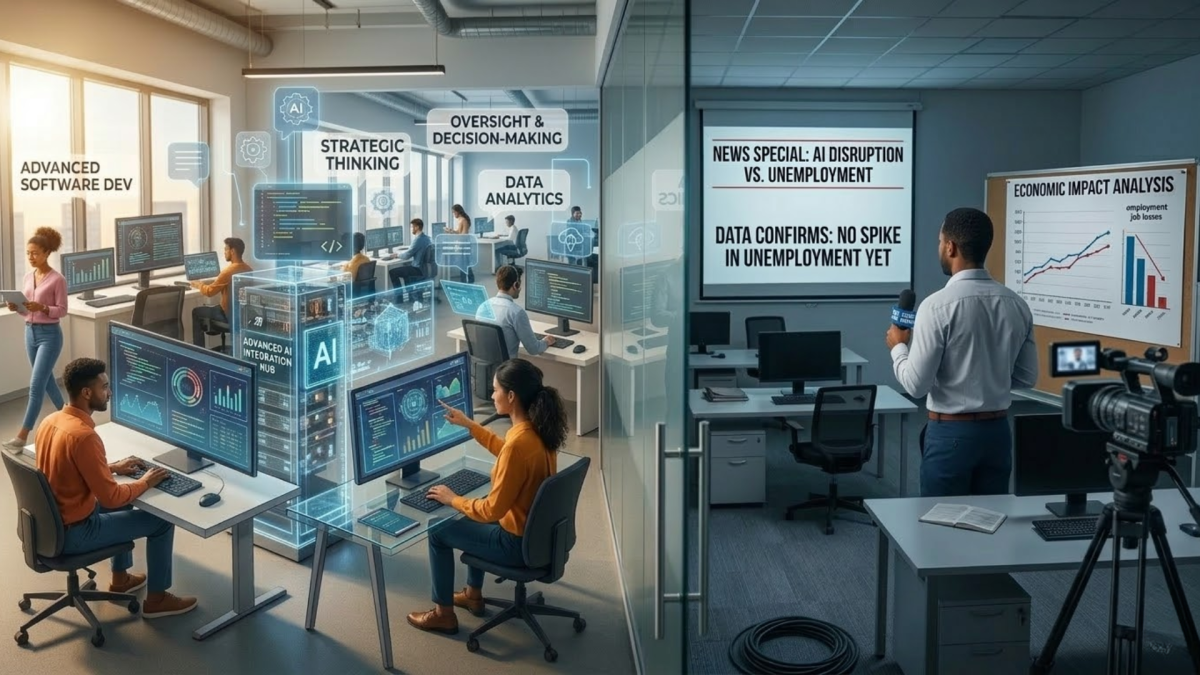
The report delivers perhaps its most significant policy insight when it separates exposure from economic disaster. In popular discourse, high exposure is often conflated with immediate, widespread unemployment. The actual labor data analyzed by Anthropic tells a more complex story. The report shows that while occupations like computer programming and customer service are experiencing profound transformation, this disruption has not yet translated into significant increases in unemployment rates for the affected workforce.
Instead, the disruption manifests as a qualitative shift in job requirements. High-exposure workers are not being immediately replaced; they are being augmented and required to adapt. Their primary challenge is navigating a new analytical environment where they oversee the AI that once performed the task. For existing professionals, the bottleneck appears not to be immediate job loss, but rather a substantial transformation of the skills and daily tasks that define their career. This subtle but critical finding underscores the importance of interpreting labor market signals with nuance.
Structural Slowdown: The Hidden Vulnerability in Entry-Level Hiring
The report uncovers a potentially severe, and largely overlooked, long-term consequence of AI integration: a structural slowdown in new hiring. This effect is subtle, multi-faceted, and disproportionately affects the youngest and least experienced segments of the workforce. Anthropic’s model projects that, although existing workers are adaptable, high-exposure fields are projected to experience slower future growth in job creation.
The visual data presents a stark divergence between two key metrics. First, while broad unemployment has not spiked, specific sectors like entry-level customer support roles show a marked decline in new job postings and junior position hires. This suggests that AI integration may be making existing roles more efficient, reducing the immediate need for a large junior labor pool to manage volume. Second, the hiring slowdown is particularly severe for young professionals. Entry-level programming roles, long seen as reliable stepping stones, now show signs of a hiring bottleneck. This finding is critical: it suggests that the real long-term danger of AI is not immediate job elimination for current professionals, but a gradual 'hiring frost' that blocks the critical pathway for newcomers into these sectors. This creates a systemic challenge for workforce planning and educational systems on a global scale.

Conclusion: Beyond Speculation to Strategic Workforce Adaptation
The Anthropic report, "Capabilities VS Usage Framework," is a landmark achievement in the systematic and data-driven analysis of AI's labor market impact. By meticulously comparing the theoretical potential of generative AI with empirical labor data, researchers have moved the conversation past vague speculation towards actionable insight. This study powerfully separates disruption from disaster. While high-exposure fields like programming and customer service are experiencing a skills bottleneck, it is not yet leading to immediate, broad-scale unemployment for existing professionals.
Instead, the disruption creates a unique vulnerability in entry-level hiring for younger workers. Anthropic’s framework, projecting sectoral slowdowns in new job postings, is perhaps its most critical policy implication. It provides a long-term early warning system that allows educational systems and policymakers to pivot towards adaptation and new skills training before potential economic bottlenecks become critical. Ultimately, this research provides the tools necessary to move past fear and embrace the hard work of strategic, global, and equitable workforce adaptation in the AI era.