OpenAI’s new financial platform co-developed with Morgan Stanley automates company research, financial modeling, and cited pitchbooks; GPT-6 Astra enables AI to autonomously construct complex technical Revit architectural models from basic prompts; and Anthropic’s 2030 forecast warns that while AI may expand US GDP by 32.4%, it could shrink knowledge-worker wages by over 10%.
Financial Analysis and Pitchbooks Can Now Be Built Enterprise-Wide with AI
What Happened?
OpenAI released a dedicated Financial Services edition of ChatGPT built in partnership with leading institutions like Morgan Stanley and Evercore. The system connects directly to premium financial market data and firm-specific templates to analyze companies, construct financial models, and generate institutional pitchbooks while maintaining trace-back citations to source data.
So What?
Vertical-specific AI tools are shifting from generic text generation to highly regulated, data-bound analytical workflows. For leadership, this marks the end of simple trial-and-error AI usage in finance and operations; enterprise-grade precision, built-in financial data integrations, and direct source attribution are now table stakes.
Question for Your Team?
Which high-friction analytical tasks (such as client prep or financial modeling) can we standardize using specialized enterprise AI platforms this quarter to reduce turnaround time?
AI Is Now Automating Complex Technical and Engineering Blueprints
What Happened?
Demonstrations of GPT-6 Astra showcase AI executing full-cycle specialized domain tasks autonomously. Given a single prompt and reference drawing, the model built a complete BIM/Revit architectural model containing 16 apartments, 327 walls, 162 doors, and 98 windows, producing four complete drawing sheets in 1 hour and 19 minutes without human intervention.
So What?
Autonomous AI capabilities are expanding far beyond basic administrative tasks into highly specialized engineering, design, and technical workflows. Within the year, production bottlenecks will move from execution speed to domain review and strategy, meaning teams that adapt their operational pipelines to leverage autonomous modeling will operate at a radically lower cost structure.
Question for Your Team?
Where in our core technical or production workflows are senior professionals spending hours on routine execution that an autonomous AI workflow could draft for review?
Anthropic Predicts AI Will Shift Enterprise Wealth from Payroll to Software Capital by 2030
What Happened?
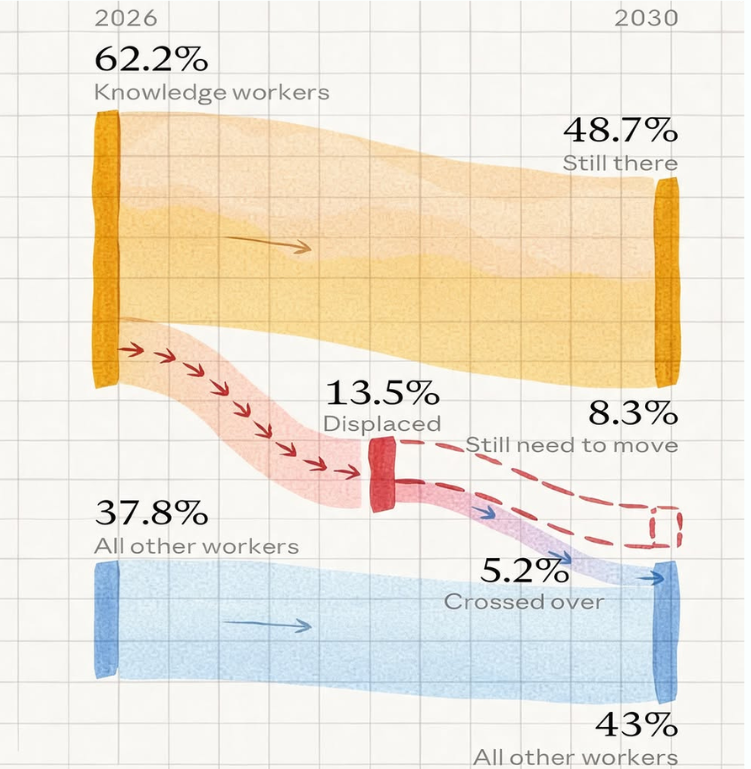
Anthropic released an economic study modeling the impact of advanced AI on labor dynamics through 2030. In its extreme scenario, US GDP expands by 32.4%, while knowledge-worker wages fall over 10%, and labor's share of overall economic output contracts from 62.2% down to 48.7% as automated compute absorbs high-level tasks.
So What?
While this macro scenario does not require immediate operational changes today, it signals a fundamental restructuring of the knowledge economy over the next three to five years. Long-term organizational resilience will depend on structuring teams around strategic judgment, proprietary leverage, and multi-agent management rather than headcount capacity.
Question for Your Team?
If routine analytical and drafting labor costs trend toward zero over the next three to five years, what unique value will our team deliver that software cannot replicate?