
The Rise of the Tenacious Agent: Inside GPT-5.6 Sol
GPT-5.6 Sol is OpenAI’s new flagship model built for autonomous, self-correcting agent work. Instead of just answering prompts, it actively tests its own logic, patches its own code bugs, and crushes industry benchmarks while offering massive cost-savings for enterprise workflows.
Following a brief delay due to government regulatory checks, OpenAI has officially launched its newest flagship model: GPT-5.6 Sol. Sparing no ambition, Sol is built not just to answer your questions, but to actively work alongside you as a highly persistent, self-correcting agent.
A New Paradigm: Frontier Intelligence Meets the Sol Family
The release of GPT-5.6 Sol marks a fundamental shift in how we collaborate with artificial intelligence. Historically, users have focused on getting the "perfect prompt" to retrieve the best possible answer on the first try. Sol rewrites this playbook. It is designed from the ground up to explore alternative logical paths, run internal tests, and dynamically revise its strategy as it works.
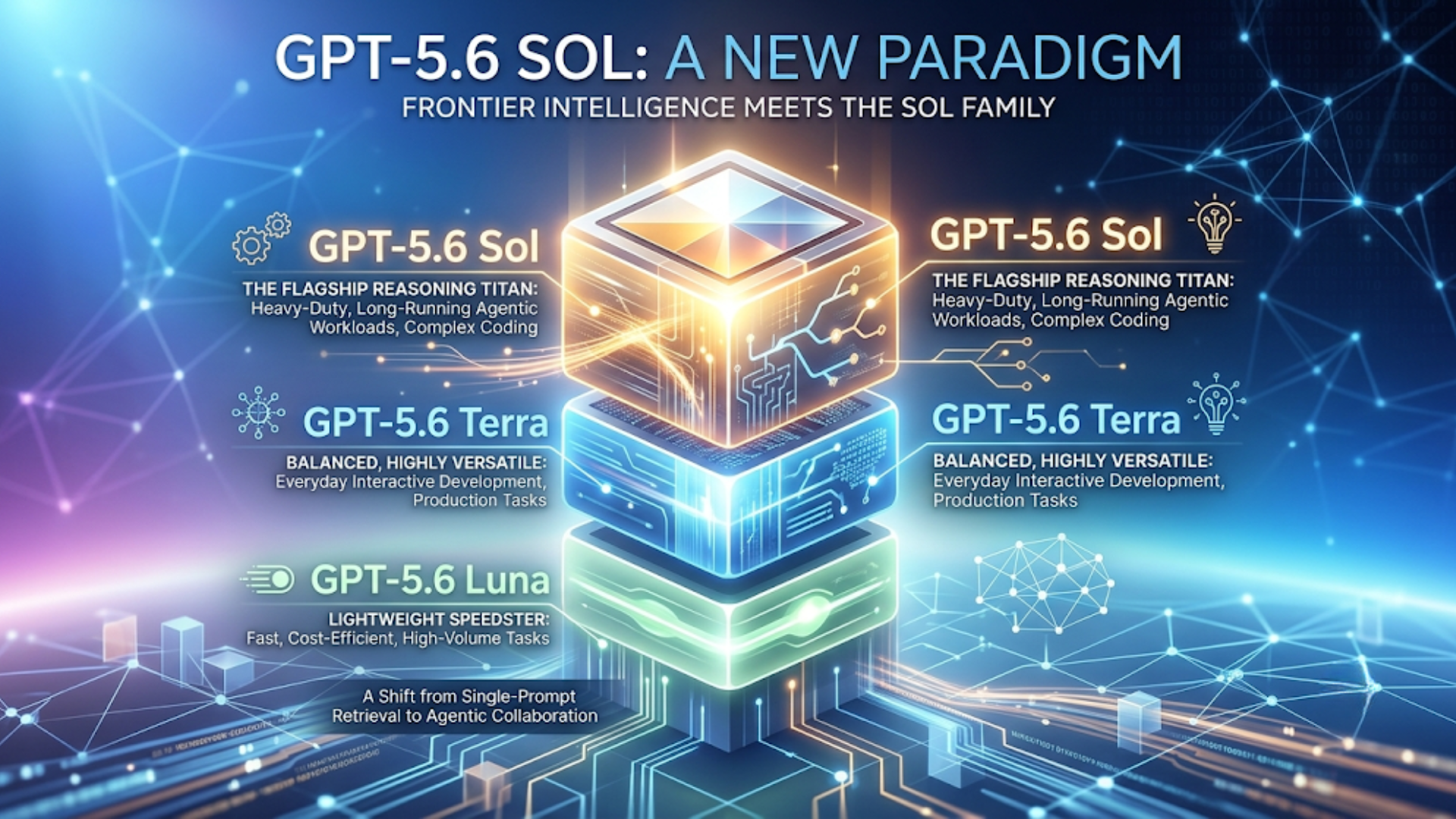
Sol sits at the absolute pinnacle of OpenAI's new GPT-5.6 tier:
-
GPT-5.6 Sol: The flagship reasoning titan built for heavy-duty, long-running agentic workloads and complex coding tasks.
-
GPT-5.6 Terra: The balanced, highly versatile mid-tier option designed for everyday interactive development and production tasks.
-
GPT-5.6 Luna: The lightweight speedster, optimized for fast, cost-efficient, high-volume tasks.
Breaking the Scales: Mind-Bending Benchmarks
To truly understand how Sol redefines "state-of-the-art," we only need to look at its record-breaking performance across major industry benchmarks. It doesn't just edge out competitors like Anthropic's Claude Fable 5—it shifts the competitive landscape entirely.
-
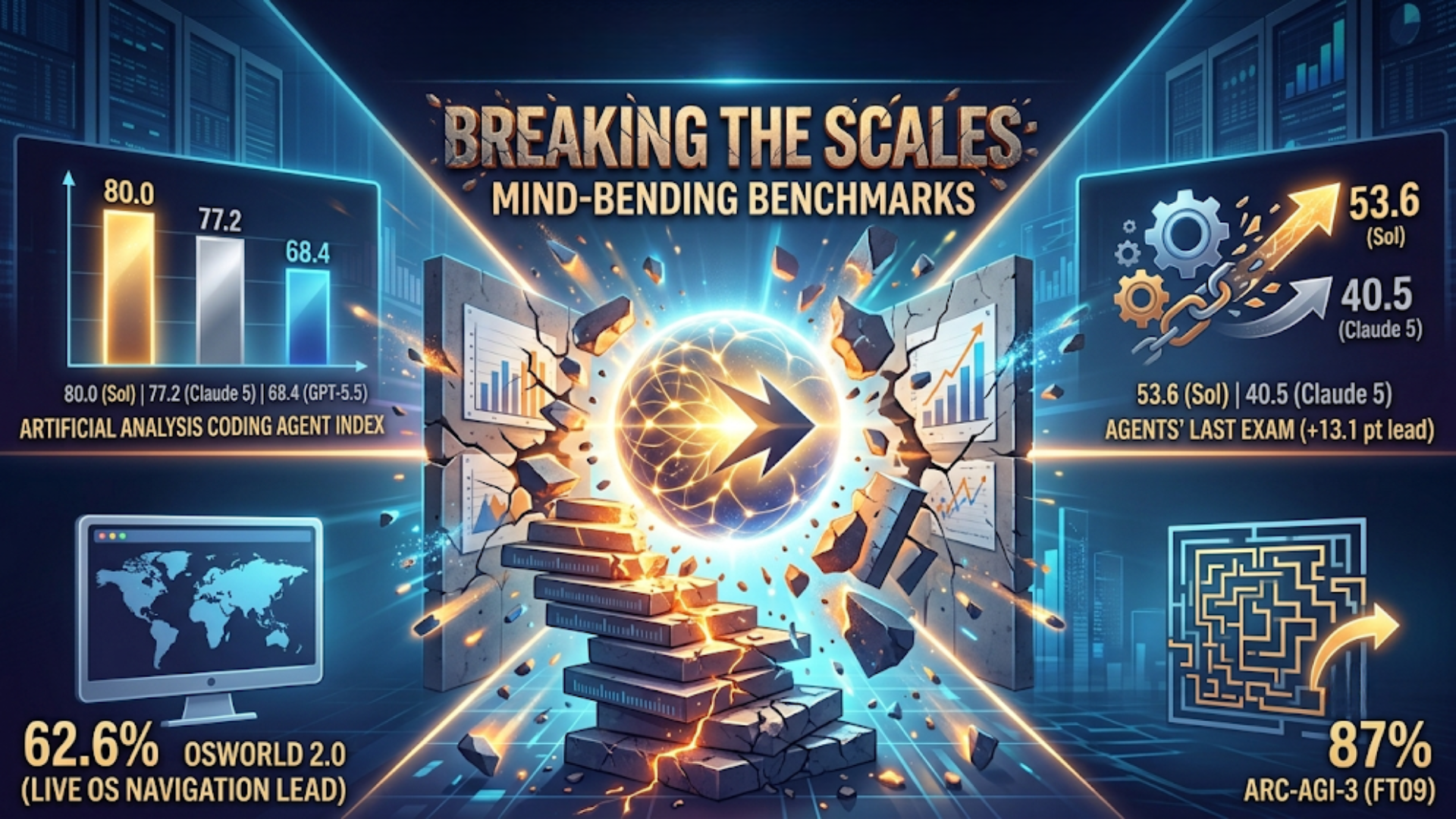
The Coding Champion: On the Artificial Analysis Coding Agent Index, Sol set a new state-of-the-art score of 80.0, beating Claude Fable 5 (77.2) and GPT-5.5 (68.4) while using up to 85% fewer output tokens.
-
The Professional Standard: On Agents’ Last Exam—which evaluates complex, long-running workflows across 55 fields—Sol achieved a score of 53.6, eclipsing Claude Fable 5 by an incredible 13.1 points.
-
Next-Gen OS Navigation: Testing its ability to navigate live computer systems on OSWorld 2.0, Sol scored 62.6%, solidifying its lead in hands-off execution.
Solving the Unsolvable: Sol is the first model to successfully win an ARC-AGI-3 public game (scoring 87% on the FT09 challenge). It proves that the model doesn't just memorize patterns—it can actively orient itself and problem-solve in completely unfamiliar digital environments.
Persistent, Efficient, and Enterprise-Ready
Sol’s true power lies in its execution. Built for massive projects, it introduces a Variable Effort Dial. By default, it operates with high efficiency, but users can dial it up to "Max Reasoning" for incredibly dense logical, mathematical, or scientific problems. Under Max settings, Sol monitors its own intermediate progress, builds lightweight helper programs to test its assumptions, and fixes its own code errors before showing you the results.
Furthermore, it is designed to minimize the cost of long-running tasks. Sol features explicit cache breakpoints that bill repeated workspace and system context at a massive 90% discount. This makes agentic workflows sustainable for enterprises, even when processing hundreds of files.

Conclusion: The Era of True Autonomous Collaboration
GPT-5.6 Sol isn't just an incremental update; it represents the transition from "chat assistant" to "autonomous colleague." Whether it is hunting down bugs in an unfamiliar codebase, executing complex tasks across Google Drive and Microsoft 365 via the new "ChatGPT Work" desktop application, or safely executing cybersecurity checks, Sol is built to carry the heavy load. The era of the tenacious AI agent has officially arrived.