
The Mind of the Machine: Why Claude is the Professional Choice
Anthropic’s Claude is the professional choice for AI, prioritizing raw reasoning and deep analysis over consumer gimmicks. Powered by Constitutional AI, the Claude 4 lineup, featuring Haiku 4.5, Sonnet 4.6, and the powerhouse Opus 4.7 with its logic-checking "Extra High" effort mode, delivers unmatched performance. With autonomous features like multi-tab browser execution, Claude Code's "Auto Mode," and real-time visual collaboration via Claude Design, it transcends basic chat assistants. Ultimately, its natural writing voice and massive data capacity make it an indispensable powerhouse for engineers, analysts, and academics alike.
In a crowded landscape of AI assistants focusing on real-time voice gimmicks and flashy visual generators, Anthropic’s Claude has quietly become the undisputed gold standard for power users. Built on a foundation of safety, deep intellectual analysis, and unparalleled linguistic nuance, Claude doesn't just generate text, it thinks. For professionals who require rigorous coding, flawless writing, and enterprise-grade reliability, Claude has firmly established itself as the thinking person’s AI.
The Architecture of Thought: Inside the Claude 4 Era
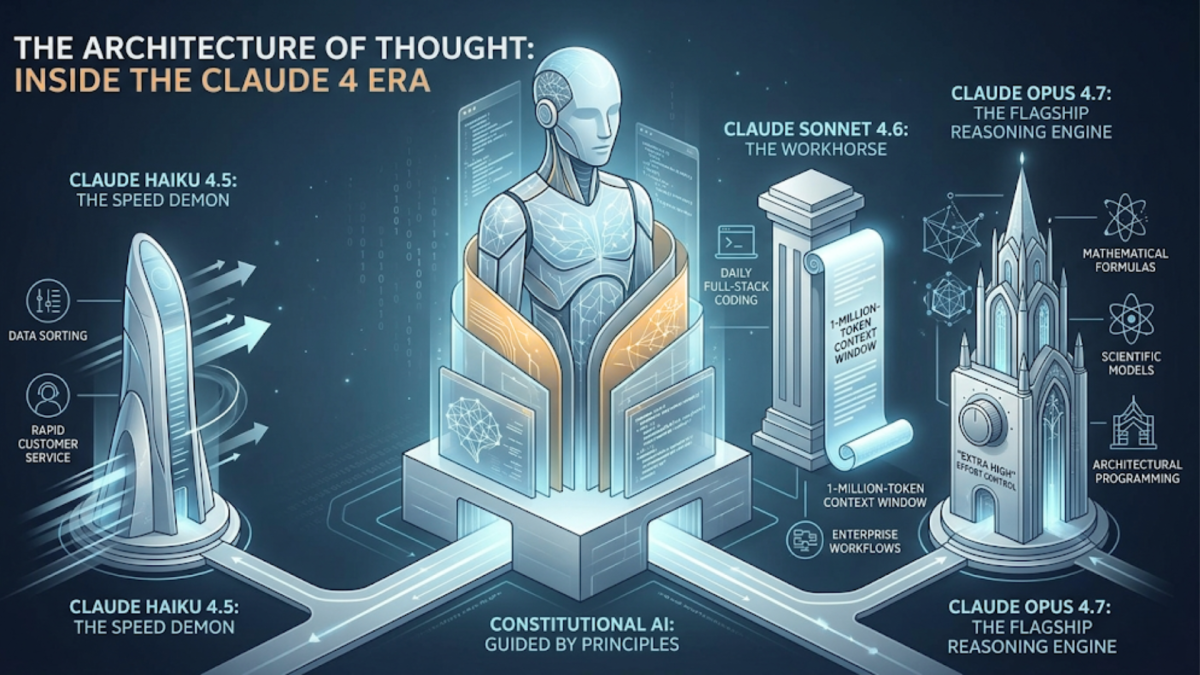
Anthropic’s philosophy has always differed from its competitors. Founded by former OpenAI researchers dedicated to AI safety, the company pioneered Constitutional AI, a training method that guides the model using a specific set of ethical principles rather than just human feedback. This deep-rooted focus on alignment has birthed an AI known for the most articulate, human-like, and nuanced writing voice in the industry, entirely free from the robotic clichés that plague other models.
To power this thoughtful engine, Anthropic utilizes a highly strategic three-tier lineup in its current generation:
-
Claude Haiku 4.5: The speed demon. Near-instantaneous and highly cost-effective, it is engineered for high-volume, lightweight tasks like data sorting and rapid customer service.
-
Claude Sonnet 4.6: The workhorse. Striking a perfect balance between speed and razor-sharp intelligence, Sonnet features a massive 1-million-token context window in beta, making it the default choice for daily full-stack coding and complex enterprise workflows.
-
Claude Opus 4.7: The flagship reasoning engine. Released in April 2026, Opus introduces an "Extra High" effort control level. This groundbreaking feature allows users to command the model to pause, allocate extra computing power, and triple-check its logic on incredibly complex mathematical, scientific, or architectural programming problems before delivering an answer.
Next-Gen Capabilities: From Generation to Autonomous Action
Claude has evolved from a passive conversationalist into an active collaborative partner. By moving past simple text prompts, Anthropic has introduced game-changing features that redefine how humans work with artificial intelligence:
-
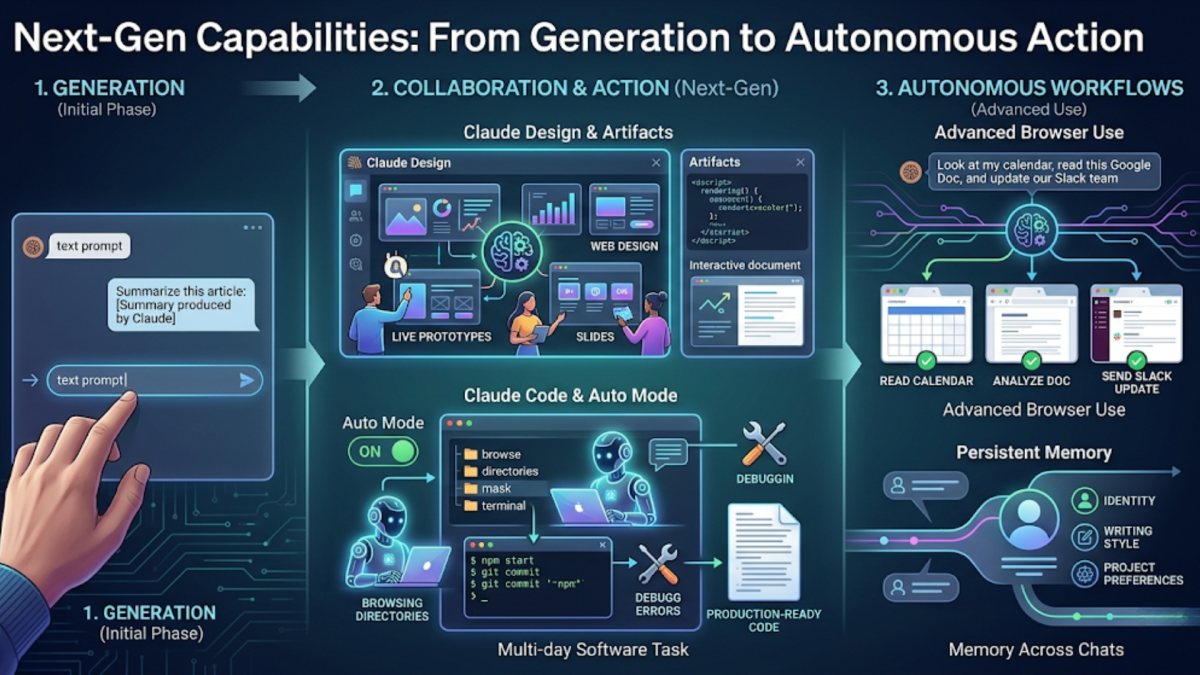
Claude Design & Artifacts: Operating inside a dedicated dashboard, Claude Design allows users to collaborate with the AI in real time to generate slides, visual prototypes, and full UI/UX web designs. This pairs perfectly with the Artifacts window, which lets you see code, websites, and interactive documents render live alongside your chat.
-
Claude Code & Auto Mode: For software engineers, Claude's "Auto Mode" represents a paradigm shift. Instead of just writing small code snippets, you can hand Claude a multi-day software task. It will autonomously browse your local files, execute terminal commands, debug its own errors, and write production-ready code with minimal human intervention.
-
Advanced Browser Use: Claude can now interact across multiple browser tabs simultaneously. A single prompt like, "Look at my calendar, read this Google Doc, and update our Slack team," triggers Claude to navigate those web pages and execute the workflow autonomously.
-
Persistent Memory: No longer bound by the limits of a single conversation, Claude features cross-chat memory for all users (including free tiers), allowing it to remember your identity, writing style, and project preferences indefinitely.
The Professional Edge: Claude's Unique Practical Advantages
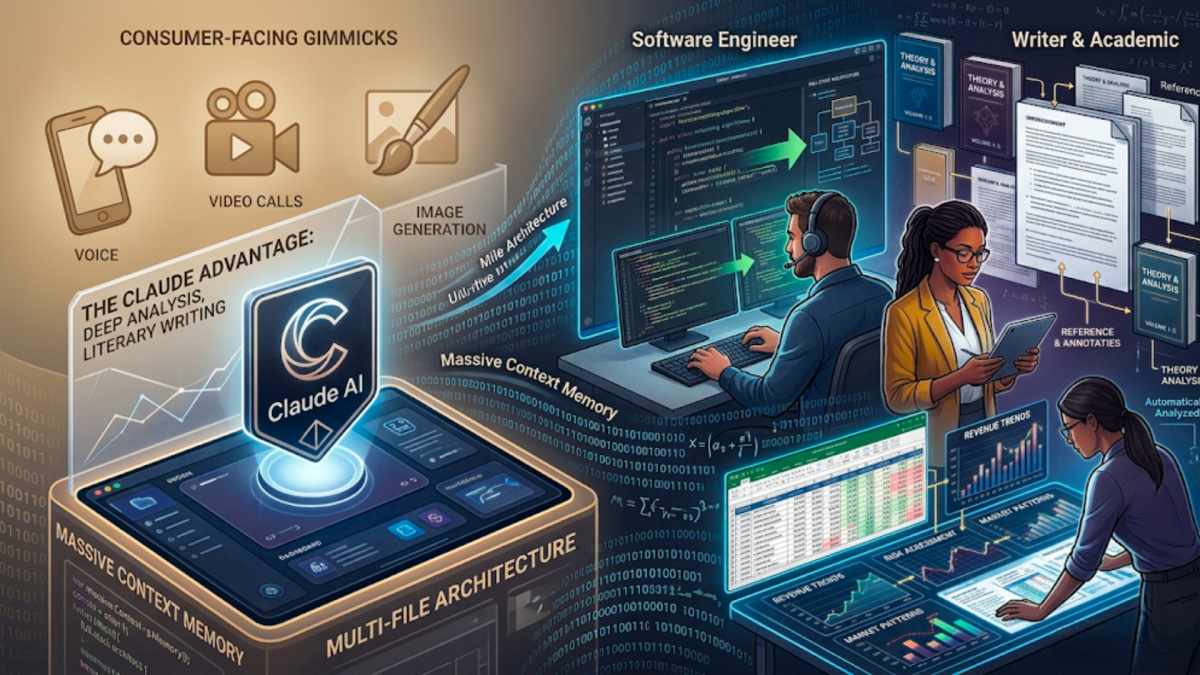
When compared to consumer-facing giants like ChatGPT, Claude’s dedication to raw horsepower and deep text/data analysis becomes immediately apparent. While competitors focus heavily on real-time voice, video features, and standalone DALL-E image generation, Claude carves out its edge through a highly expressive, literary writing style and an interactive design dashboard.
In terms of raw utility, where other AIs are great for quick code snippets and basic debugging, Claude excels at multi-file architecture and entirely autonomous coding blocks. Its core advantage lies not in consumer gimmicks, but in its massive context memory and unparalleled ability to handle deep data analysis.
Because of these distinct advantages, Claude has become the tool of choice for three specific professional pillars:
-
Writers & Academics: Who leverage its ability to ingest entire book series or dense research papers at once and synthesize them beautifully without losing the author's tone.
-
Software Engineers: Who recognize it as the ultimate companion for refactoring heavy codebases, navigating repositories, and building complex software architecture.
-
Data Analysts: Who upload massive corporate financial spreadsheets and let Claude effortlessly diagnose discrepancies, run background scripts, and uncover hidden patterns.
Conclusion: The Era of Deep Reasoning
While the broader AI industry chases viral attention with real-time voice and video features, Anthropic’s focus on pure reasoning power has paid off. By prioritizing features like the "Extra High" effort mode in Opus 4.7, autonomous browser execution, and the live collaboration of Claude Design, they have built an ecosystem designed for meaningful production. Claude isn't just an assistant to chat with; it is a profound extension of human intellect, cementing its place as the definitive choice for professionals worldwide.