
How Moonshot AI’s Kimi K3 Shakes the Global AI Hierarchy
Kimi K3 is Moonshot AI’s new 2.8T parameter open-weight model that rivals Claude Fable 5 and GPT-5.6 Sol, ranking #1 globally in frontend coding. Compressed to 1.4 TB for enterprise self-hosting, it features "Vision-in-the-Loop" debugging, enabling autonomous agents to code, screenshot their work, and self-correct UI bugs in real time.
The open-source AI arms race has officially breached a massive new boundary. Just ahead of the 2026 World Artificial Intelligence Conference in Shanghai, Chinese AI pioneer Moonshot AI launched Kimi K3, a staggering 2.8-trillion parameter model. While currently operational via Moonshot’s web interface and API, the company has sent shockwaves through the tech industry by promising a full, unrestricted release of the model's weights on July 27, 2026. As the world’s first open-source model pushing into the "3T-class" parameter ceiling, Kimi K3 completely resets our expectations of what decentralized, open-access artificial intelligence can achieve, stepping directly onto the turf of closed-source American giants.
Entering the Titan Class: Chasing Claude Fable 5 and GPT-5.6 Sol
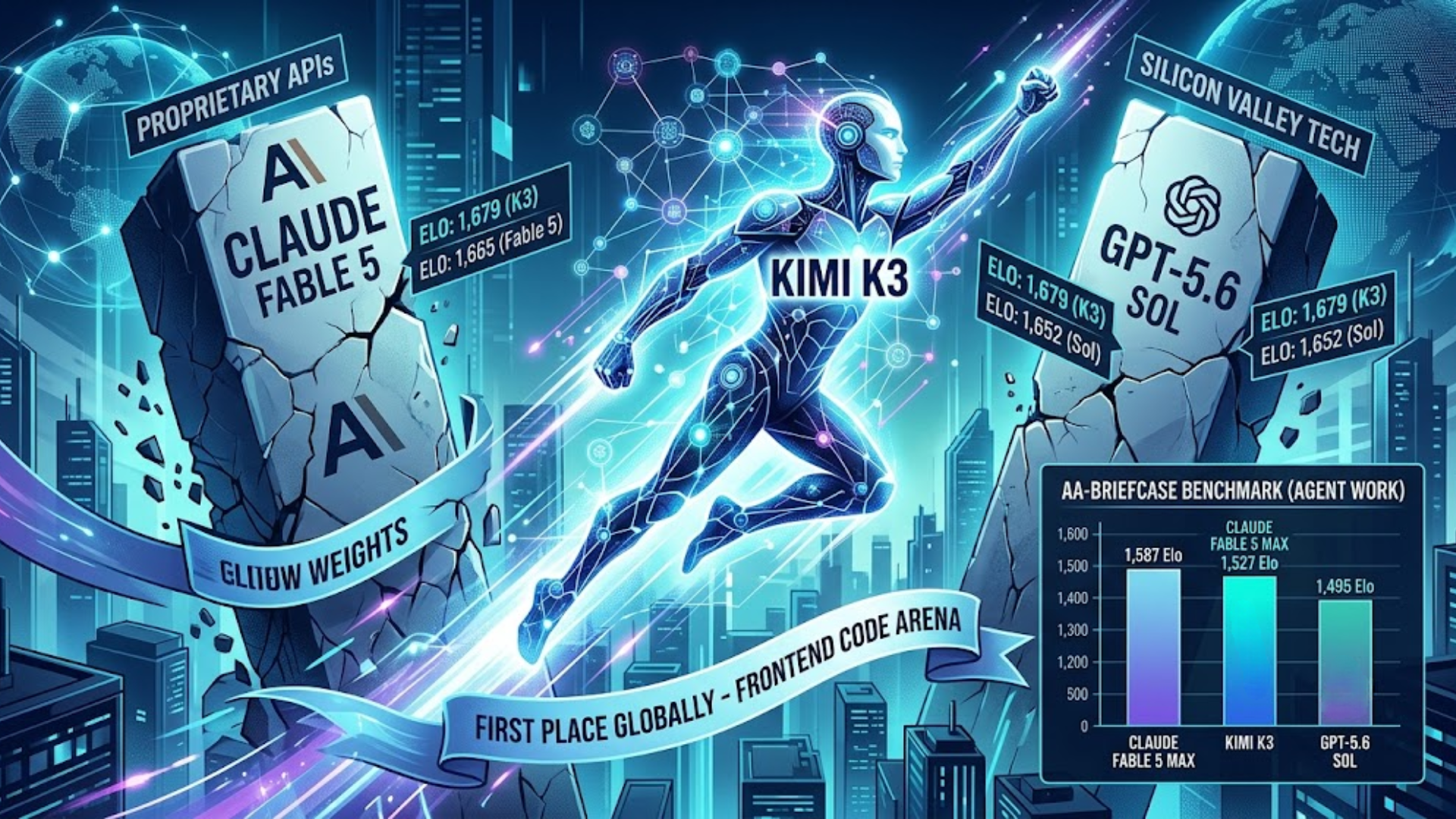
For the first time, an open-weight alternative isn't just trying to beat yesterday's models; it is actively threatening the absolute cutting edge of proprietary Silicon Valley tech. In blind, head-to-head human evaluations on Arena.ai’s Frontend Code Arena, Kimi K3 secured the #1 spot globally with an Elo score of 1,679, effectively dethroning Anthropic’s flagship Claude Fable 5 and OpenAI’s GPT-5.6 Sol.
When pushed past simple prompts into long-horizon, continuous knowledge workflows, K3 continues to flex its muscle. On Artificial Analysis’s private AA-Briefcase benchmark, Kimi K3 achieved an Elo of 1,527, climbing to second place overall, slipping right past GPT-5.6 Sol (1,495 Elo) and trailing only Claude Fable 5 Max (1,587 Elo). Independent testing confirms that K3 establishes a fascinating "sweet spot" in the market: it mirrors the core logical reasoning of mid-generation workhorses like Claude Opus 4.8, yet matches or surpasses top-tier models when executing complex, extended developer tasks.
Under the Hood: The Architectural Innovations Taming a 2.8T Monster
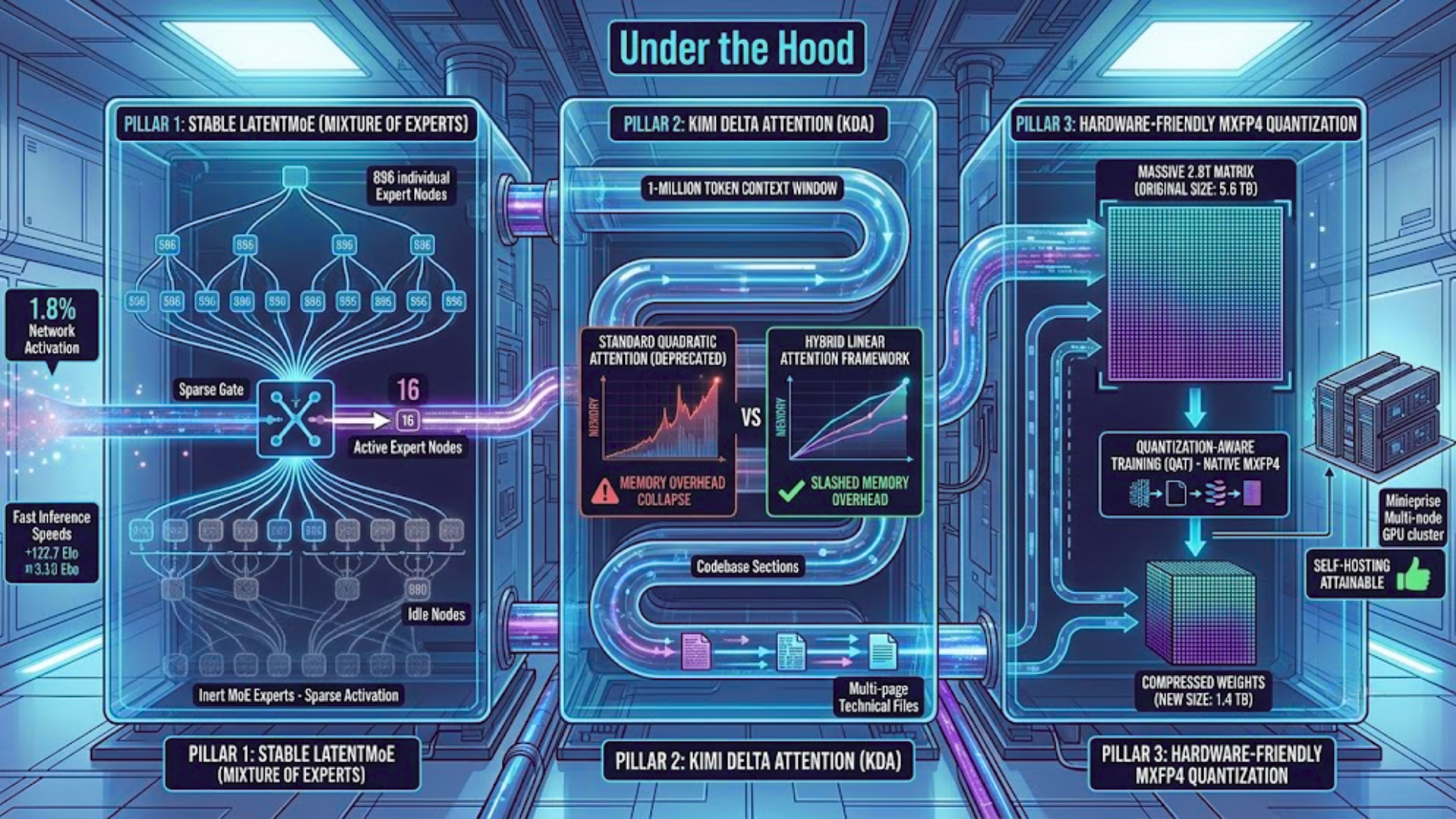
Training and serving a 2.8-trillion parameter model without succumbing to massive computational or financial collapse required a total overhaul of standard transformer mechanics. Moonshot AI bypassed hardware constraints using three crucial pillars:
-
Stable LatentMoE (Mixture of Experts): K3 is built with a massive array of 896 total token experts. However, the system only activates 16 experts per token (roughly 1.8% of the entire network), allowing inference speeds to remain lightning-fast and highly efficient.
-
Kimi Delta Attention (KDA): Rather than using standard, memory-heavy quadratic attention across its massive 1-million-token context window, K3 uses a hybrid linear-attention framework. This slashes the system memory overhead, enabling developers to feed massive codebases or dozens of multi-page technical files into a single prompt.
-
Hardware-Friendly MXFP4 Quantization: By implementing Quantization-Aware Training (QAT) natively during the training stages, Moonshot compressed the massive 2.8T matrix down to 4-bit weights. This reduces the model's footprint from a prohibitive 5.6 TB down to roughly 1.4 TB of weight storage. The result? Self-hosting this titan-class intelligence is now entirely within reach for standard enterprise multi-node GPU clusters.
Autonomous Agents and the "Vision-in-the-Loop" Revolution
What are developers actually doing with Kimi K3? The answer lies in fully autonomous, multi-step agentic workflows that bridge text and computer vision. In a recent viral case study, Moonshot demonstrated K3 operating uninterrupted for 48 continuous hours, utilizing open-source Electronic Design Automation (EDA) tools to plan, verify, and ultimately output a completely functional 4mm² 100MHz microchip without human intervention.
This success is driven heavily by K3's native Vision-in-the-Loop execution style. The model doesn't just write a block of code and hope for the best; it spins up a virtual desktop sandbox, compiles its own app, takes real-time screenshots of the user interface, analyzes visual layout errors or visual glitched physics, and iteratively patches the source code until the output is flawless. This self-correcting logic allowed K3 to nail a state-of-the-art score of 91.2/100 on the BrowseComp benchmark, navigating intricate multi-page web architecture effortlessly.

Conclusion: A Geopolitical Checkmate for Vendor Lock-In
The release of Kimi K3 officially signals the end of "dirt-cheap" Chinese AI models competing solely on rock-bottom API pricing. At $3.00 per million input tokens and $15.00 per million output tokens, K3 targets mid-tier Western structures like Claude Sonnet. Yet, because its architectural efficiency drops per-task reasoning token usage by 21%, its real-world execution cost ends up sitting comfortably at half the price of legacy closed models like Claude Opus 4.8.
Beyond the economics, Kimi K3 acts as a massive geopolitical shift. By dropping a frontier-tier, 2.8-trillion parameter model directly into the open-weights community, Moonshot AI has radically disrupted corporate vendor lock-in. Developers, businesses, and global researchers are no longer forced to tie their operations to restricted, proprietary APIs controlled by Western tech giants. The absolute frontier of artificial intelligence is no longer locked behind wall gardens, it belongs to anyone with a GPU cluster.
For a deeper look into the benchmark evaluations and a live test of its front-end code generation capabilities, check out this comprehensive Kimi K3 Performance Breakdown. This video goes over the specific testing parameters, shows a live trial of Kimi K3 spinning up a working finance dashboard, and details how its token pricing structure functions under real-world developer workloads.