How AI Tools Are Turning “Good Meetings” into “Productive Meetings”
AI tools like ClickUp Brain and Notion AI eliminate the post-meeting bottleneck by turning raw, unstructured notes into assigned task lists in seconds. By automating what used to be a 30-minute manual summary process, these assistants maintain momentum and allow teams to shift instantly from administrative write-ups to real execution.
The line between a meeting that merely feels productive and one that actually yields results often comes down to the five minutes immediately following it. Capturing key takeaways and mapping out next steps is essential, yet post-meeting documentation remains a major friction point for modern teams. By leveraging specialized AI tools, organizations can eliminate administrative friction and bridge the gap between talk and real output.
The Post-Meeting Bottleneck
For years, professionals have faced the tedious task of sifting through messy, unorganized notes after every discussion. Finding actionable points, matching commitments to specific project leads, and organizing key takeaways into clear updates often took up to half an hour of manual effort per meeting.
This post-meeting drag creates a cumulative slowdown across entire organizations. Over the course of a work week, a team conducting multiple syncs loses hours solely to formatting, re-reading transcriptions, and typing out summaries. The fundamental challenge was never a lack of insight during the discussion, it was the time-consuming write-up required to transform spoken ideas into organized, operational plans.

Instant Extraction with AI Tools
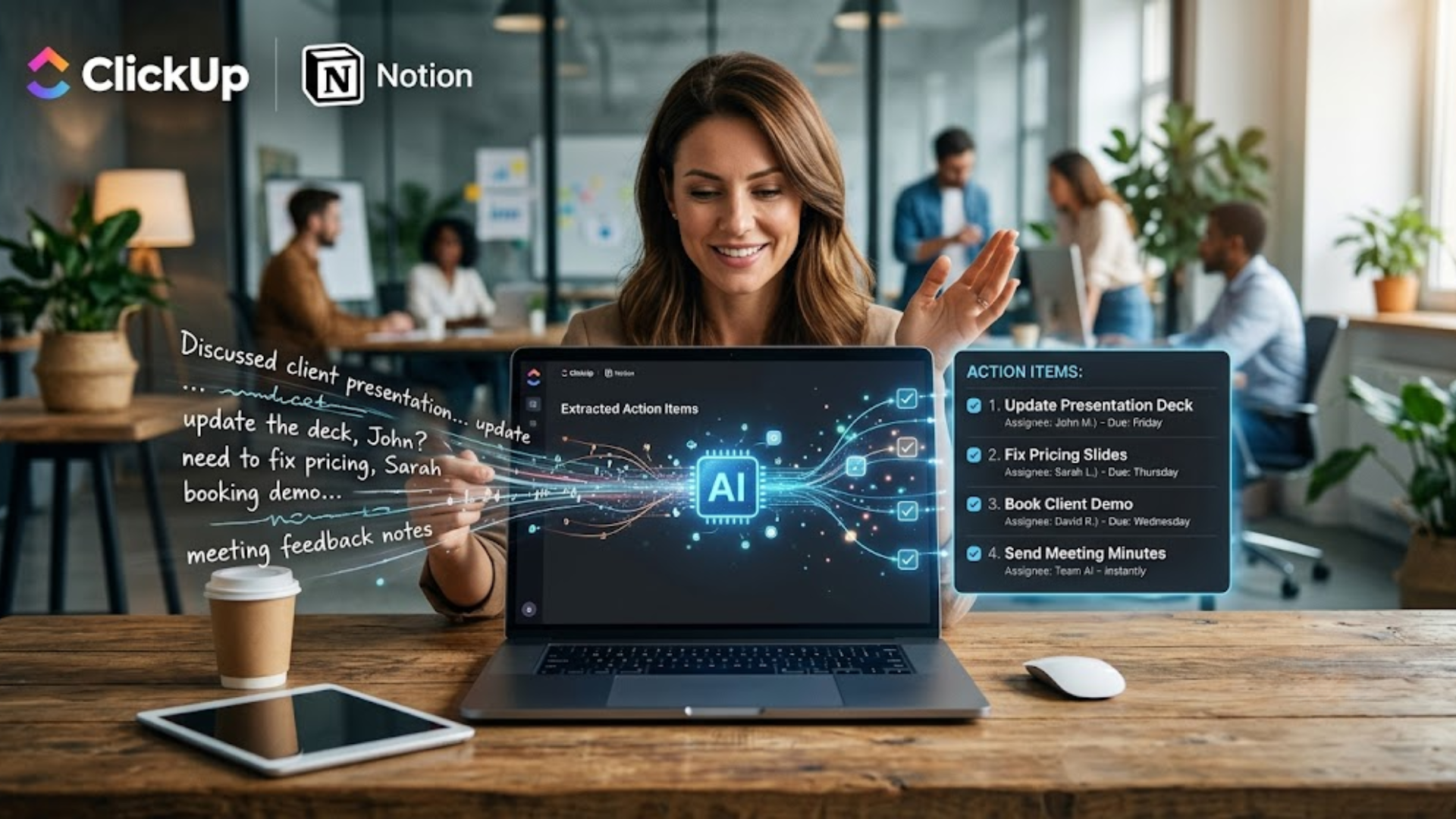
Modern productivity platforms like ClickUp Brain and Notion AI have transformed how meeting outcomes are documented and distributed. Instead of spending time manually structuring bullet points, team members can drop raw meeting notes or text transcripts directly into an AI assistant and prompt it for immediate results.
With simple natural language requests, such as asking the AI to "give me the action items with owners", unstructured discussion text is processed instantly. Within seconds, the system extracts critical deliverables and formats them into clean, assigned task lists (e.g., updating a deck, fixing pricing slides, or booking a client demo). By analyzing the context of the conversation, these AI assistants eliminate the manual step of sorting who is doing what.
Reclaiming Time for Core Execution
Delegating post-meeting documentation to AI reduces what used to be a 30-minute administrative task to the brief time it takes to walk back to your desk. This dramatic acceleration prevents momentum from stalling between discussions and allows team members to step out of a meeting with immediate clarity on their responsibilities.
Beyond saving individual effort, automating task extraction builds organizational accountability. When action items and owners are established right away, teams avoid the common post-meeting confusion over deliverables. As a result, work shifts instantly from administrative tracking to core execution, ensuring key commitments are carried out while the discussion is still fresh.

Conclusion: Inputting the Output
Converting conversation into tangible results no longer requires hours of manual typing and sorting. By adopting AI-driven workflows for post-meeting tasks, teams can eliminate administrative delays and maintain momentum from one discussion to the next. Integrating these tools into your daily workflow ensures that every meeting yields clear, immediate progress.
Watch the full video on LinkedIn 👉
https://www.linkedin.com/posts/input-the-output-ito_leadership-productivity-aiforbusiness-activity-7492854222913441793-_fHa?utm_source=share&utm_medium=member_desktop&rcm=ACoAAFlhWqEBJPAK4J991lZWOwGnQddT9G7JHhE