Gemini 4 Carbon: Google’s New #1 AI Model Explained
Google’s Gemini 4 Carbon is an autonomous frontier model that ranks #1 on industry leaderboards. It surpasses rivals like Claude Opus 5.5 and GPT-6 Astra by delivering major upgrades in software engineering, operating system automation, advanced STEM reasoning, and cybersecurity.
Google has introduced Gemini 4 Carbon, its most advanced artificial intelligence model to date. Dropping just two weeks after the release of Gemini 4 Argon, Carbon quickly climbed the leaderboards to secure the overall number one ranking in the AI industry. It brings substantial upgrades in general reasoning, coding, and day-to-day usability.
Taking the Top Spot Across Major Rankings
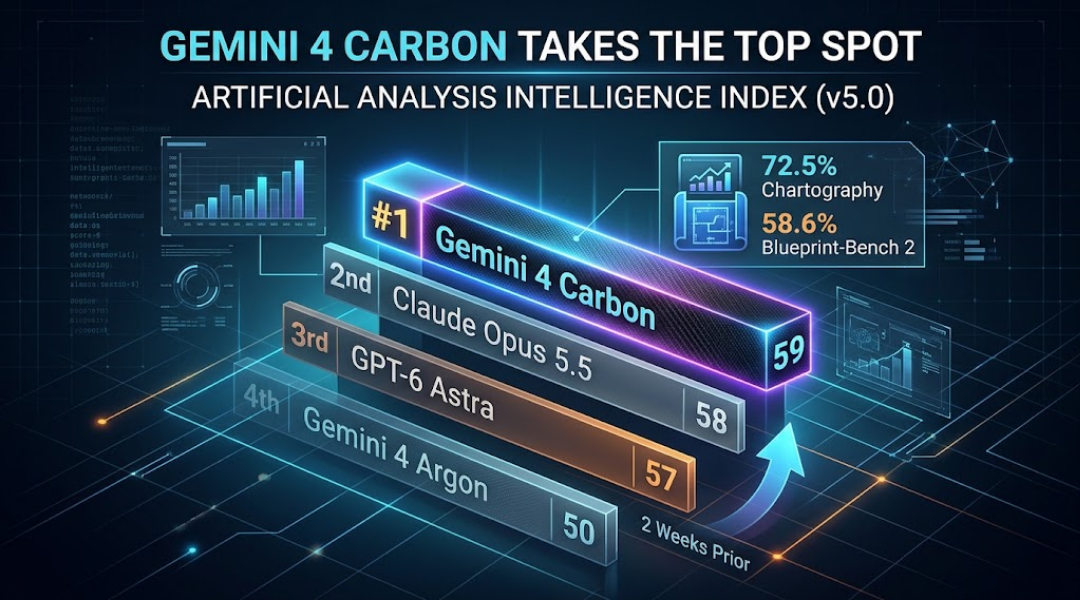
Gemini 4 Carbon sits at the very top of the Artificial Analysis Intelligence Index (v5.0) with an overall score of 59.
-
Outperforming industry rivals: It pulls ahead of major flagship models, surpassing Claude Opus 5.5 (score: 58) and GPT-6 Astra (score: 57).
-
A massive leap over Argon: It improves significantly upon Gemini 4 Argon, which launched two weeks prior with an index score of 50.
-
Sharper visual comprehension: Carbon excels at interpreting technical visuals, achieving a 72.5% accuracy rate on Chartography and 58.6% on Blueprint-Bench 2.
Stronger Practical Coding and Real-World Tasks
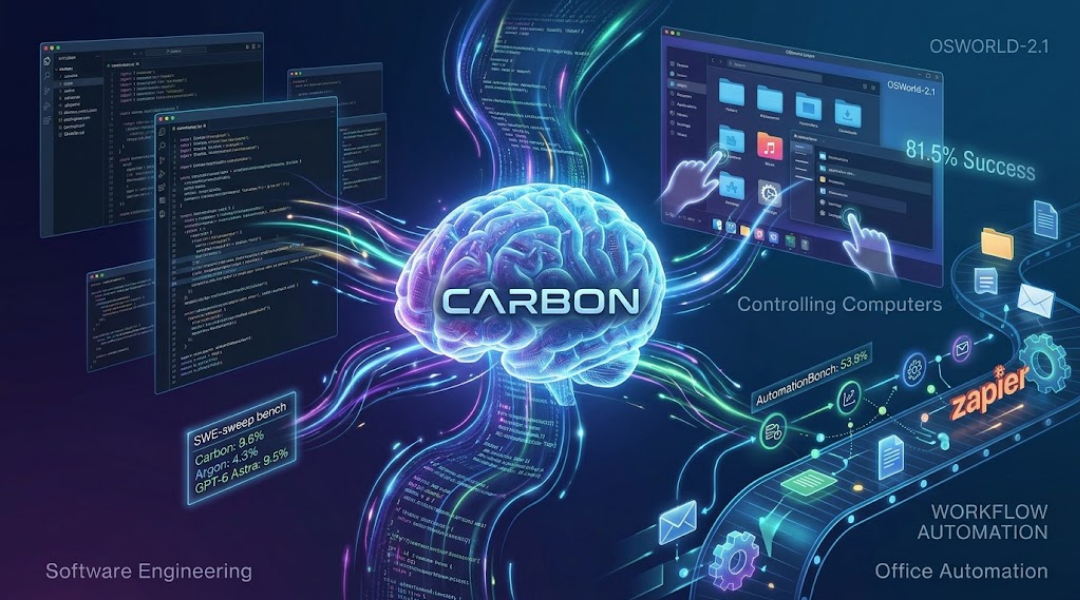
Rather than just serving as a conversational chatbot, Carbon is optimized to function as an autonomous agent that writes code, operates computers, and handles office workflows.
-
Software engineering: On the SWE-sweep coding benchmark, Carbon resolved 9.6% of issues, more than doubling Argon’s 4.3% and edging out GPT-6 Astra (9.5%).
-
Controlling computers: In the OSWorld-2.1 test suite, Carbon scored 81.5%, demonstrating that it can navigate applications and operating systems with minimal human oversight.
-
Office automation: In workplace simulations using tools like Zapier, Carbon led the field on AutomationBench with a 53.9% success rate.
Advanced Skills in Science, Math, and Cybersecurity
Carbon handles complex technical challenges that require rigorous logic, specialized knowledge, and scanning massive amounts of information.
-
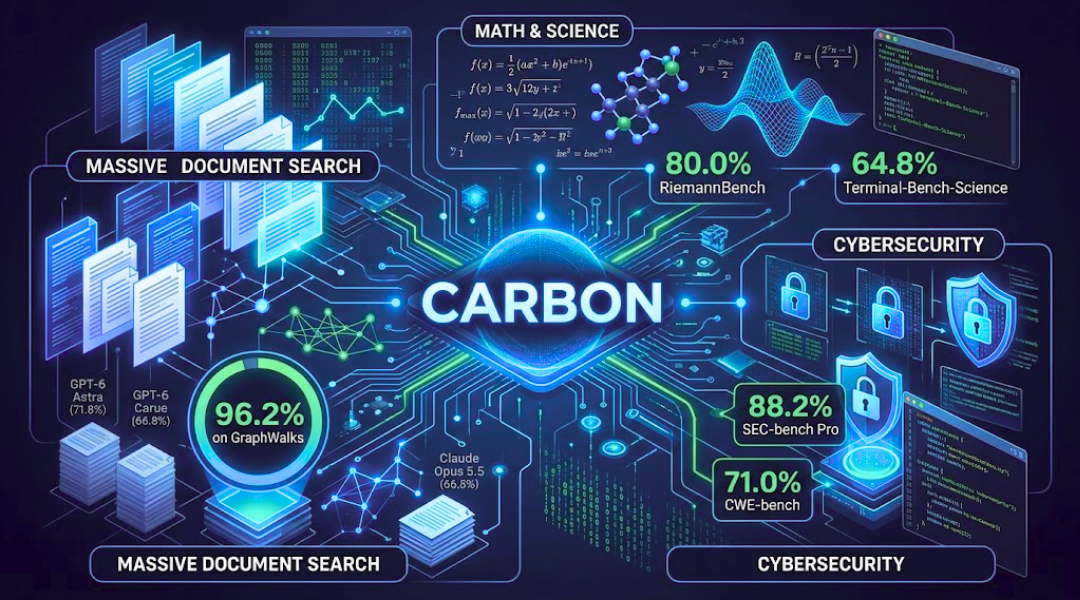
Massive document search: When reading documents up to 1 million tokens long, Carbon scored 96.2% on GraphWalks tests, outperforming GPT-6 Astra (71.8%) and Claude Opus 5.5 (66.8%).
-
Higher-level math and science: The model scored 80.0% on RiemannBench and 64.8% on Terminal-Bench-Science, proving adept at complex problem-solving.
-
Software security: Carbon achieved an 88.2% on SEC-bench Pro and 71.0% on CWE-bench, marking a major step forward in its ability to detect code vulnerabilities and digital security threats.
Conclusion: A New Era of Autonomous AI Performance
The arrival of Gemini 4 Carbon highlights a clear turning point in how artificial intelligence is measured and deployed. Modern AI models are no longer judged solely on how natural their dialogue sounds; the real competition has shifted toward autonomous capability, technical depth, and actionable problem-solving.
By dominating leaderboards across software development, long-context analysis, and cybersecurity, Gemini 4 Carbon shows that Google’s aggressive release cycle is delivering tangible leaps in frontier performance. Moving from conversational assistant to reliable technical collaborator, this release establishes a new benchmark for what businesses, developers, and researchers can expect from frontier AI systems.