Beyond the AI Free-for-All: Why Team Alignment Beats Individual Adoption
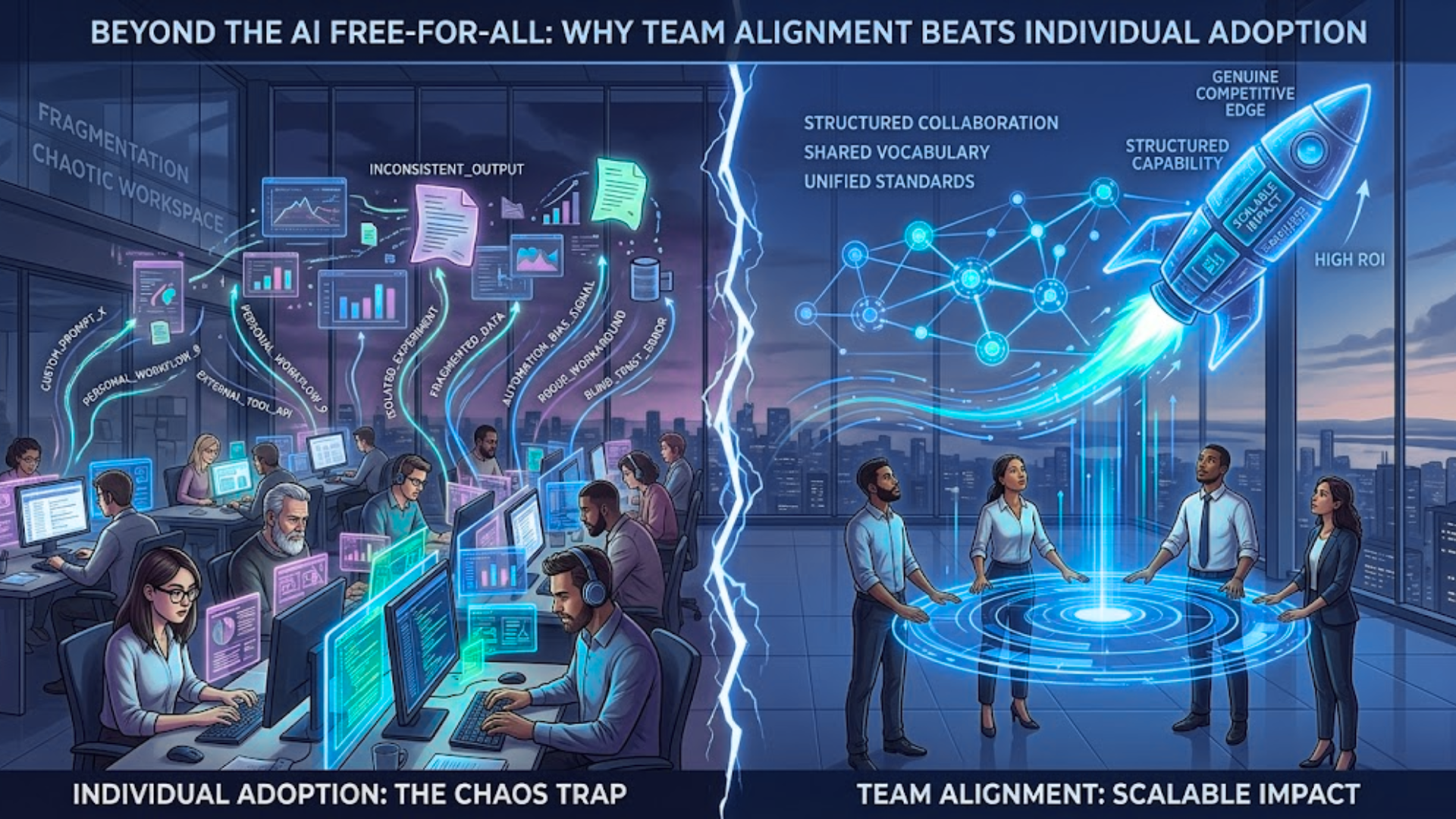
Leaving employees to figure out AI individually creates a chaotic workplace with inconsistent outputs and zero shared standards. To get actual value from AI, companies must prioritize group training over extra software. Aligning your team around a shared vocabulary and standardized baseline ensures consistent results before you invest in further tools.
In the rush to capture the promise of enterprise artificial intelligence, modern organizations are falling into a predictable trap. Leaders routinely hand out AI software subscriptions, instruct individual employees to "figure out how it helps," and wait for productivity to surge. However, sending employees on solo missions to master AI tools creates a fragmented, chaotic workspace rather than an efficient one. True operational capability emerges not from isolated experimentation, but from structured, collective alignment.
The Cost of the "Do Your Own Thing" Approach
When AI adoption is left entirely up to individual initiative, workplace efficiency suffers from severe fragmentation. Without shared direction, ten employees assigned to the same core task will create ten wildly different, half-fluent approaches.
This unguided strategy creates significant operational hurdles:
-
Inconsistent Deliverables: Output quality varies dramatically depending on an individual employee’s prompt engineering skill and critical evaluation.
-
Automation Bias and Blind Trust: Without guided standards, workers often exhibit "automation bias"—accepting incorrect AI outputs simply because they look polished and confident.
-
Collaboration Silos: When every team member relies on custom prompts, personal workarounds, or disparate external software, sharing workflows or cross-training colleagues becomes nearly impossible.
"High adoption without alignment leads to high activity, but zero scalable business impact."
Establishing Common Ground Through Group Enablement
Group enablement addresses the root cause of scattered adoption by transforming AI from a personal trick into a collective competency. Learning together enables teams to build a shared internal vocabulary, define acceptable quality thresholds, and align around enterprise compliance guidelines.
Structured group learning provides several immediate advantages:
-
Unified Baseline Capabilities: Instead of a small group of isolated "power users" while everyone else lags behind, the entire team reaches the same foundational proficiency.
-
Rehearsal over Theory: Group environments allow teams to practice and "rehearse" real-world workflows together—learning when to trust the model, how to critique outputs, and how to defend AI-assisted decisions to stakeholders.
-
Repeatable Process Automation: Teams move past one-off prompts toward standard, repeatable workflows for key departmental outputs like proposals, research synthesis, and reporting.

Aligning the Team Before Expanding the Tech Stack
A common leadership misstep is assuming that buying more licenses or deploying sophisticated autonomous tools will automatically resolve productivity gaps. If an organization lacks a baseline framework for how employees interact with AI, throwing more software at the problem only amplifies existing confusion.
Before investing in advanced platforms, closing the alignment gap must be the top strategic priority. When a team operates with a unified baseline, future technology investments pay off far more predictably:
-
Higher Return on Investment (ROI): Standardized usage ensures new tools are actually embedded into day-to-day operations rather than remaining unused after kick-off.
-
Scalable Governance: Establishing safe data practices and clear guardrails across a unified group is far simpler than policing hundreds of distinct, rogue workflows.
-
Faster Onboarding: New hires can easily adopt established, documented AI workflows rather than inventing their own from scratch.

Conclusion: One Team, One Standard
AI tools are only as effective as the strategic consistency of the people operating them. Moving away from unstructured individual trial-and-error toward standardized, collective learning enables organizations to eliminate operational waste and turn scattered experimentation into a genuine competitive edge.
Watch the full video on LinkedIn 👉
https://www.linkedin.com/feed/update/urn:li:activity:7493940780613640192