

While tech giants rush to redesign the entire internet around automated agents and synthesized summaries, a silent rebellion is growing among everyday users. People are looking for the "off" switch. Following a massive push for forced AI integrations across major search engines, DuckDuckGo launched a dedicated solution: browser extensions that route searches through a completely sanitized, AI-free version of the web. The response was explosive. On May 28, 2026, traffic to DuckDuckGo’s No-AI page tripled, and US app installations spiked by over 30% week-over-week. The old-school, raw internet is suddenly a hot commodity.
Inside the Sanctuary: What is noai.duckduckgo.com?
The massive surge in traffic isn't driven by a minor settings toggle, users are flocking to a fundamentally different search experience. The dedicated noai.duckduckgo.com portal completely strips away the modern "bloat" of the AI era.
First and foremost, it entirely blocks AI-generated summaries and automated answer boxes at the top of the screen. Instead of reading a machine's synthesis of an article, you are immediately presented with the actual sources. It also banishes predictive search assistance and conversational prompts that try to nudge you into a chatbot interface.
Crucially for 2026, the engine filters out AI-generated images by default, solving a major frustration for users tired of wading through deepfakes and synthetic graphics when looking for real photos. What is left is a fast, clean return to the classic "10 blue links" era, focusing entirely on raw source material, speed, and clean information architecture.
The Power of Choice vs. Forced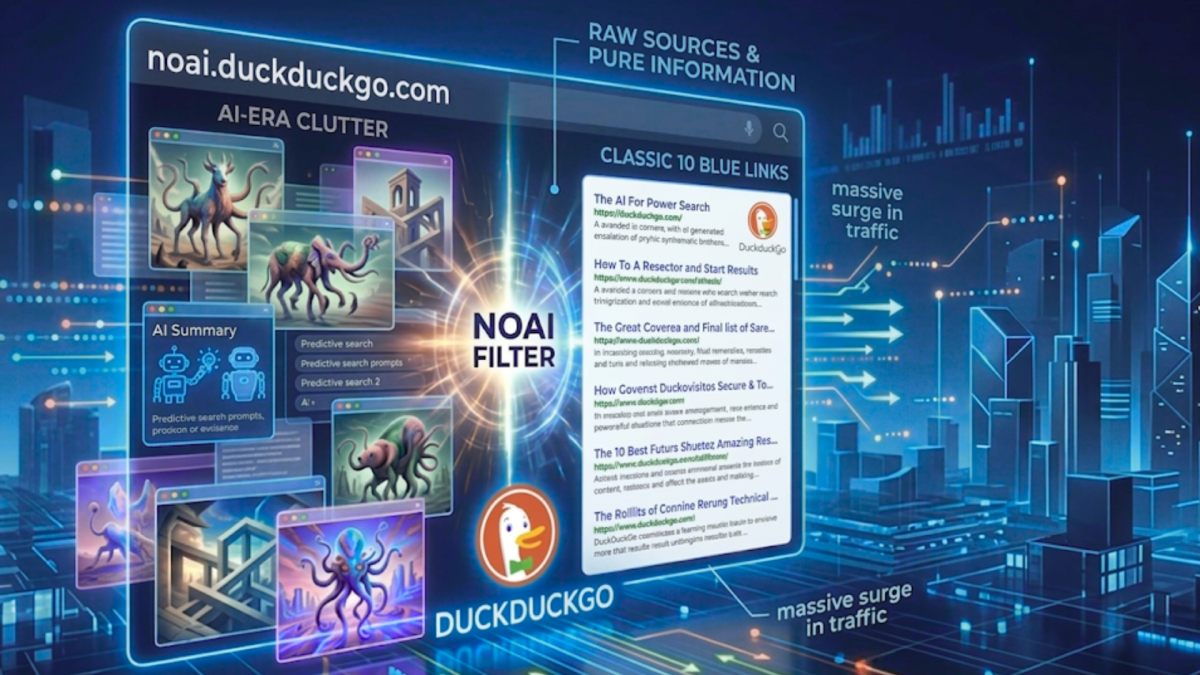 Integration
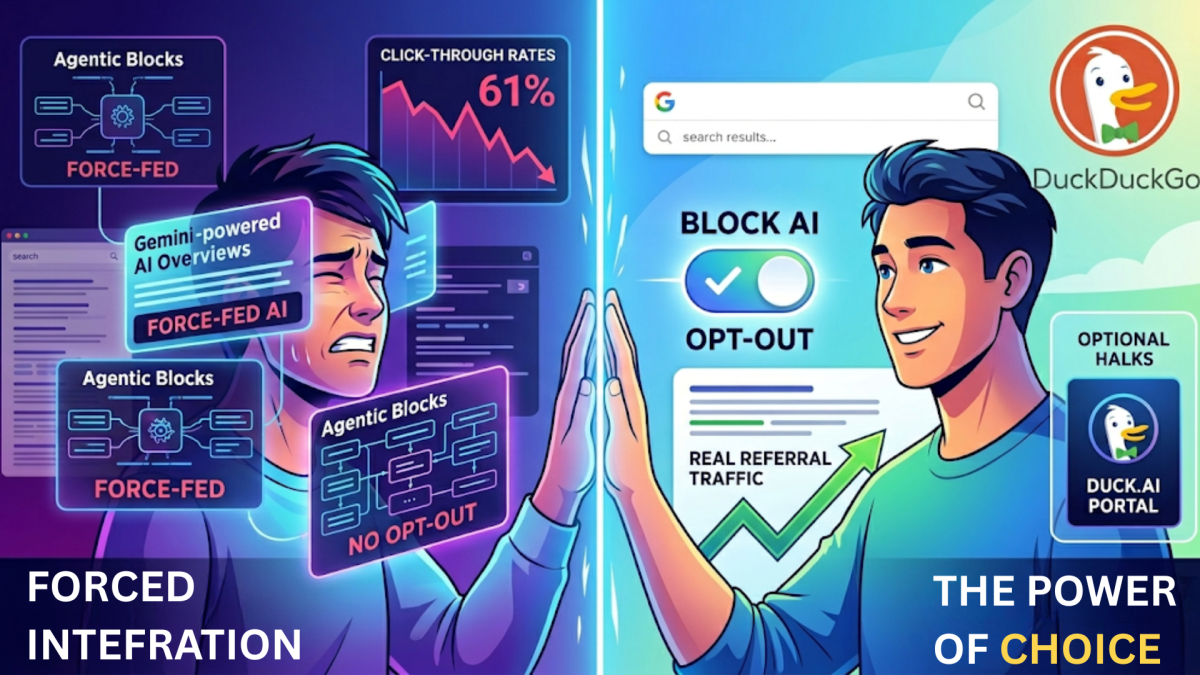
It is important to note that DuckDuckGo isn't actually an anti-AI company. They actively run their own private chatbot portal (duck.ai). Instead, their core philosophy centers on a concept that larger tech giants seem to have forgotten: user choice. DuckDuckGo believes AI should be an optional tool, not an unavoidable overlay.
This creates a stark contrast with Google's current stance. While Google forces users into Gemini-powered AI Overviews and agentic blocks with no native, permanent opt-out, DuckDuckGo allows users to block AI entirely. Furthermore, while Google's AI-heavy search results have caused website click-through rates to plummet by roughly 61% due to "zero-click" searches, DuckDuckGo's No-AI version preserves traditional referral traffic. DuckDuckGo CEO Gabriel Weinberg explicitly called out this environment, noting that platforms are "force-feeding AI with no way to opt out." By creating a dedicated, easily accessible alternative, DuckDuckGo has positioned itself as the premier destination for user control.
The Three Forces Driving the AI Exodus
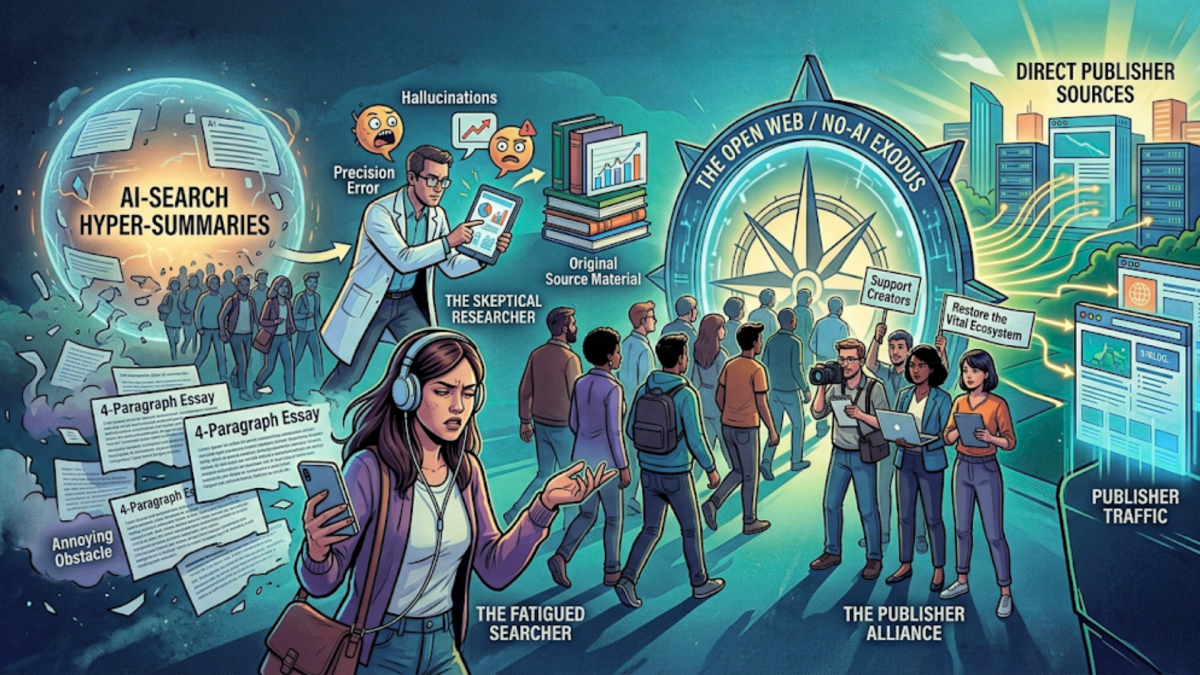
Who exactly is driving this traffic explosion? The rebellion is being fueled by three distinct groups of users:
-
The Fatigued Searcher: Many users are experiencing conversational fatigue. When you just need a quick login portal, a weather update, or a direct link to a local business, reading a four-paragraph AI-generated essay is an annoying obstacle, not a feature.
-
The Skeptical Researcher: Despite continuous updates, AI summaries still struggle with precision and hallucinations. Users looking for high-stakes medical, financial, or highly technical data simply do not trust a machine synthesis. They prefer looking at original, authoritative source material directly.
-
The Publisher Alliance: Content creators, journalists, and web publishers are actively backing the No-AI movement. Because traditional AI search engines scrape website data to answer questions directly on the search page, they drastically cut the traffic sent to actual creators. The No-AI page preserves the vital ecosystem of the open web by sending clicks back to publishers.
Conclusion: The Two-Tiered Future of the Web
The sudden explosion of the No-AI movement proves that search is splitting into two distinct environments. On one side is a web built for convenience, where users want an AI agent to do the reading, synthesizing, and formatting for them. On the other side is a web built for purists, researchers, and creators who demand raw data, maximum speed, and absolute privacy.
By recognizing this divide, DuckDuckGo has proven a fascinating product truth: in an era where tech companies are desperate to add as features as possible, sometimes providing a simple "off switch" is the most valuable feature of all.