
The traditional image of a software engineer, hunched over a mechanical keyboard, staring into the glow of dual monitors, is officially facing an existential threat. The arrival of Monako Glass, a lightweight pair of smart glasses running a native Linux operating system, signals the dawn of "vibe coding" on the move. Built explicitly for software engineers and AI builders, this device shifts the paradigm of development from manual typing to high-level, voice-driven architectural curation.
Desktop Power in a 48-Gram Frame
Fitting a complete development environment onto a user's face without resorting to a bulky, front-heavy headset required a ground-up reimagining of hardware and software efficiency. Weighing a mere 48 grams, Monako Glass looks indistinguishable from standard eyewear while packing an ultra-compact computer architecture.
The secret lies in its dedicated operating system, MonoOS, a custom Linux build optimized specifically for wearable constraints. Rather than dragging down performance with heavy UI frameworks, MonoOS utilizes a hyper-efficient Lua application layer. This allows essential developer apps to run smoothly with a remarkably low memory footprint of just 200KB to 500KB.
To bridge the gap left by the missing mouse and keyboard, the glasses feature an onboard 0.5 TOPS NPU vision engine. This low-power chip tracks hand and palm gestures in real time, allowing developers to bring up system menus with a raised hand or tweak code parameters with mid-air sweeps.

Voice-Driven App Creation via Agentic AI
What transforms Monako Glass from a passive heads-up display into a legitimate development workstation is its native integration with leading agentic AI tools like Anthropic’s Claude Code and OpenAI’s Codex. Developers are no longer writing lines of syntax; they are dictating systems.
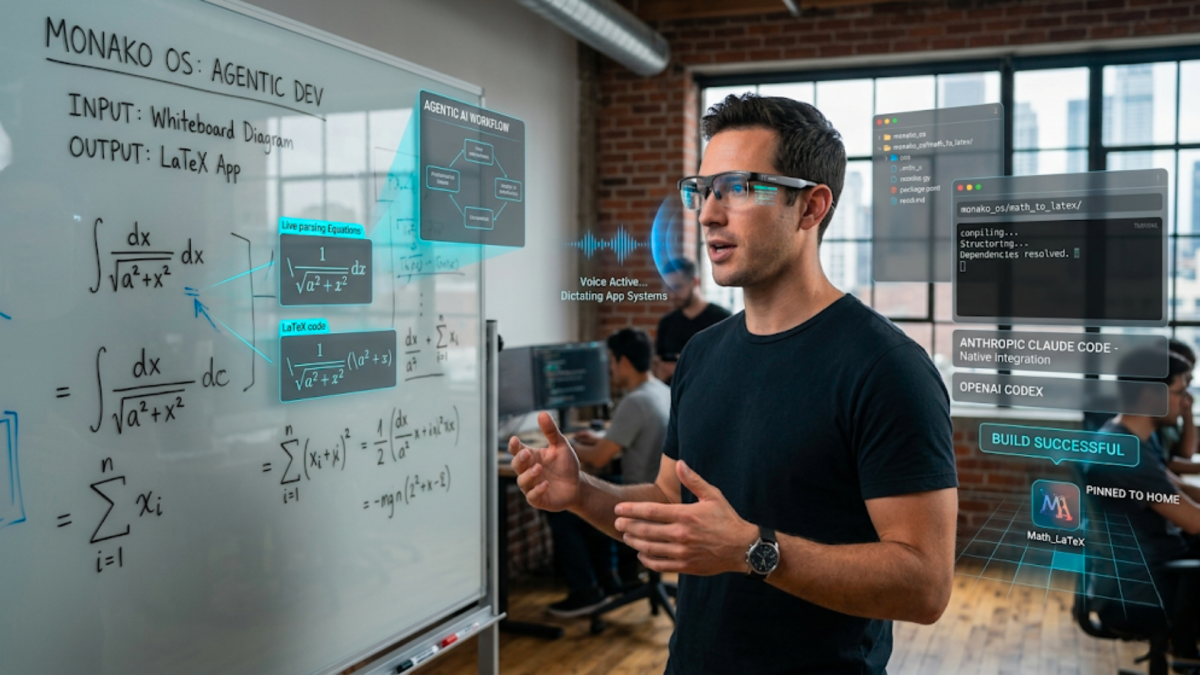
The development loop is entirely conversational. For example, a developer can stand in front of a whiteboard, look at a diagram, and issue a verbal prompt: "Build an app that converts these handwritten math equations into LaTeX formatting."
From there, the internal AI agent takes over, handling the heavy lifting of compiling the architecture, structuring files, and resolving dependencies in the background. Once the build is successful, MonoOS automatically compiles the package and pins the newly minted application directly to the glasses' home screen, ready for deployment.
The Nose-Bridge Hack for Flawless Isolation
Voice-prompted coding has historically failed in real-world environments because standard microphones cannot separate spoken code from the chaos of a public space. Monako bypasses this environmental noise through a unique hardware solution: a specialized bone-conduction microphone sitting directly on the nose bridge.
Instead of capturing sound waves traveling through the air, the microphone reads the physical vibrations of the user's nasal bone as they speak. This mechanical isolation completely filters out external audio. Whether working from a packed coffee shop or testing a build on a noisy subway platform, the voice recognition engine receives a clean audio signal, ensuring that background noise never corrupts a prompt or scrambles a command.

Conclusion: The Shrinking Workspace
Monako Glass marks a distinct shift in how we think about productivity tools. By decoupling software development from physical desks and keyboards, it proves that the ultimate integrated development environment (IDE) might not be a heavier laptop or a larger screen, but a highly optimized pair of spectacles and a clear voice. As local AI models grow more capable, the workspace will continue to shrink, leaving developers free to build complex software from anywhere their feet can take them.