AI as Your Workplace Anger Translator: How to Defuse Hostile Emails Without Losing Your Cool
When confronted with rude or aggressive workplace emails, firing back in anger can quickly endanger your job or client relationships. Instead of reacting impulsively, you can feed the provocative message into an AI tool like ChatGPT or Claude alongside a prompt asking for a radically professional, polite reply that sets firm boundaries. Within seconds, the AI strips away heated emotion and translates your frustration into a poised, de-escalating response that holds others accountable and protects your career.
Receiving a rude or passive-aggressive email from a manager or demanding client can derail your entire workday. Your immediate impulse might be to hit reply and fire back in anger, but an emotionally charged response can quickly endanger a key project or put your job at risk. Instead of reacting impulsively, you can use generative artificial intelligence as an objective filter, translating raw workplace frustration into sharp, boundary-setting professionalism.
The Cost of the Emotional Reply: Why Impulsive Responses Backfire
When faced with aggressive messages like "Why is this STILL not done? I needed it YESTERDAY," natural instincts urge us to defend ourselves immediately. However, firing off a retort in the heat of the moment shifts the spotlight away from the actual workplace issue and places it on your behavior. An emotional email can damage client relationships, cause internal friction, and compromise career stability. Stepping back before sending a response prevents a temporary grievance from becoming a permanent professional setback.

The Solution: Leveraging AI to Translate Anger into Radical Professionalism
Rather than bottling up frustration or letting it dictate your words, you can use conversational AI tools like ChatGPT or Claude as an emotional buffer. By pasting the provocative email directly into the model and giving explicit instructions, the AI strips away emotional reactivity while preserving your core boundaries.
A proven prompt to use is:
"Read this email. I am extremely frustrated. Write a reply that is radically professional, sets firm boundaries, but keeps the tone polite."
This guides the tool to produce a measured reply within seconds, delivering the necessary pushback without violating workplace decorum.

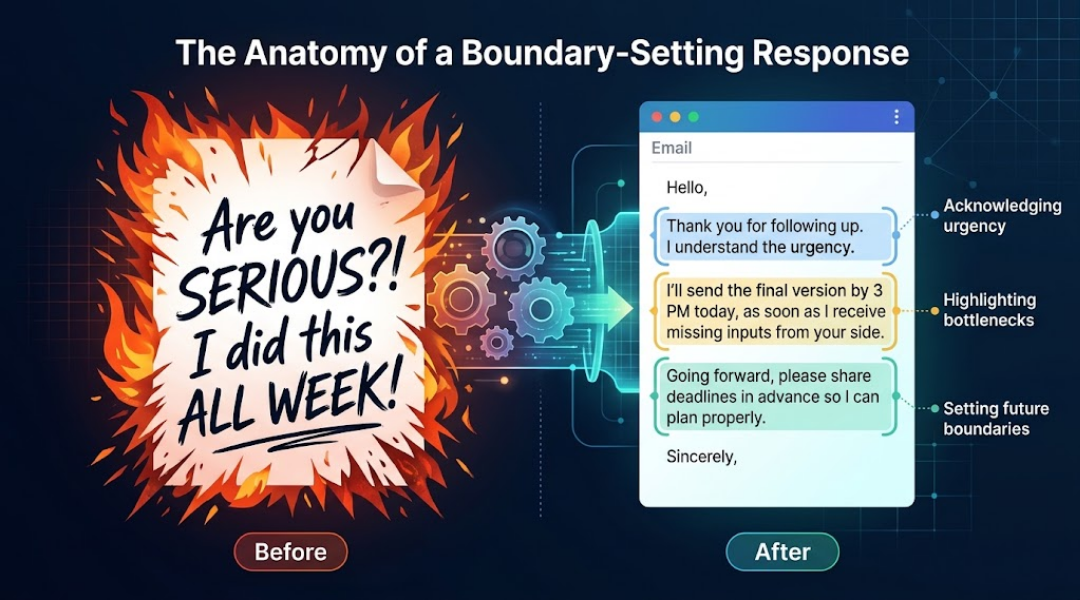
Anatomy of a Boundary-Setting Response: How the Translation Works
A well-crafted AI translation replaces confrontational complaints with clear facts and future conditions. For example, instead of firing back "Are you SERIOUS?! I did this ALL WEEK!", the translated email reframes the situation constructively:
-
Acknowledging urgency without admitting fault: Starting with "Thank you for following up. I understand the urgency" de-escalates the tension immediately.
-
Highlighting external bottlenecks: Stating "I'll send the final version by 3 PM today, as soon as I receive the missing inputs from your side" holds others accountable for delays politely.
-
Setting future boundaries: Adding "Going forward, please share deadlines in advance so I can plan properly" establishes expectations to prevent repeat occurrences.
Conclusion: Mastering the Art of Firm, Professional Communication
Difficult emails and high-stress deadlines are inevitable in any professional career, but reacting defensively doesn't have to be your default. By using AI as an anger translator, you protect your professional standing, establish necessary boundaries, and ensure your message commands respect rather than conflict. Next time a toxic email arrives in your inbox, pause, let AI handle the translation, and respond with poise.
Watch the full video on Instagram 👉
https://www.instagram.com/reel/De9pbWUqK-7/?rpxt=NWxyeGNrOG94bzcz